BEST WORLD LIFESTYLE
Station 10 Continuous line simulator
R14 · 27 September 2026
Station 10 inspection · Station 11 loading · Station 12 closing / horizontal placement
OPTION 1 · METERED Y-GATE
Guide each carton into its selected branch
Isolate one carton, confirm the gate position, release it and confirm the exit. The 0.54 s routing budget supports the 100/min normal-production target in this model.
OPTION 2 · PARALLEL SIDE TRANSFER
Locate the NG carton. Push it sideways. Confirm its exit.
A guided pusher transfers the complete carton across a bridge plate onto a parallel reject belt. The next carton is held until the pusher is HOME. Good cartons continue straight.
AETEC independent concept. Dimensions and timings are provisional. The reference video's mechanism has not been verified. Dense NG flow reduces the model's upstream release rate.
 AETEC · www.aetec.net
CAD tooling · Conventional camera / lens concept · Indicative layout.
Confirmed final outfeed
After carton closing and routingTwo travel-unit lines, three stations in series
Bottle line: yellow holders carry eight bottles through S10 and S11. After S11 unloading, the empty module turns downward and returns on its lower track.
Carton line: a separate module carries eight prepared open cartons beside S10, docks at S11 for QR registration and loading, then carries the upright loaded cartons to S12. Its empty modules also return underneath.
S11: both units must be docked. The robot loads eight bottles and overhead vision checks insertion. S12: overhead vision checks carton presence; the robot lifts eight cartons, closes them locally and transfers sideways onto the adjacent parallel belt conveyor.
MODEL COMPONENTS
Two independent travel-unit fleets
Route time 0.00 s- Upstream supply
- Station 10 scan
- Transfer as one unit
- Station 11 pack eight
- Station 12 close / lay flat
- Track or QR re-read
Transfer module Bottle module: S10 scan → S11 unload → downward end turn → lower return → reload
Eight cartons Open carton module: S10 preparation area → S11 QR / bottle loading → S12 overhead presence / robot pickup / closing → ordinary conveyor, QR face down → tracking or optional stand-up re-read → selected reject station
Station 10 sequence
Module stays docked until all eight bottles are returned8 independent rotary axes
Stop on detection · 185° maximum search · No angle restorationRead 1 and Read 2 are separate captures at each independently stopped angle. Vision pairs A1/B1 through A8/B8 correspond to bottle positions 1–8, with two light bars per head. Completion order follows detection, not random flashing. Unverified channels stay lit until the inspection window ends.
Bottle-to-carton tracking
Each module’s slots 1–8 stay linked to bottle identities and eight carton positions. The existing robot places all eight together; the ledger records each result.
| Slot / bottle | QR verification | AI tracking | Carton QR / identity method | Presence / closure | Route / confirmation |
|---|
Event record
Simulation timeLine capacity / scenarios
Target timing model, not a measured production result. Playback speed changes presentation speed only.
Complete process and release conditions
One moving unit carries eight yellow holders. It remains at Station 10 throughout pick, scan and return.
Pick eight → XYZ transfer → focus / stabilise → independent search → stop → two identical reads → return to the same holders.
Both independent modules dock and lock. Register the eight carton QRs at Station 11, then let the robot pick all eight bottles.
Transfer and place eight bottles into eight cartons together. AI records each placement; software matches bottle and carton identities.
After placement and robot clearance, the empty bottle module turns downward and returns on its lower track.
Station 12 robot closes each loaded carton and lays it horizontally, QR face down. Inspect closure / condition. Keep the reserved carton identity with AI + encoder tracking, or add a tilt / re-read / lay-down cell. Meter and confirm each physical exit.
Every required bottle identity, QR verification, placement observation, carton association and closure / packaging check must pass. This is the release rule, not a claimed measured AI accuracy.
PASS → Good carton outfeed confirmed
NG → Entire affected carton, including an empty carton, routed to the selected reject conveyor
UNCERTAIN → Hold, reconcile and confirm recovery
CAD dimensions and component references
Tooling, holders and focus mechanisms are imported from Q9B Bwl Bottle Line Proposal A.STEP. The browser mesh retains 577 original components after replacing 16 camera bodies and 16 oversized lens models with conventional industrial-camera geometry. Dimensions are measured from the supplied CAD mesh and rounded; they are not certified catalogue dimensions.
The articulated arms, transfer loop, Station 11 loading and Station 12 closing equipment, supporting frame, cabinet, cabling and carton conveyor are concept additions. The yellow holders and carrier retain supplied CAD geometry; the transport path is schematic. Their envelopes and operating paths remain subject to engineering verification. The model shows a rectangular industrial body, C-mount-style cylindrical lens, focus / iris rings, front glass, rear connectors and a motorised focusing track. Appearance follows conventional machine-vision cameras; body / lens dimensions are indicative and optical selection remains open.
Option 1 · Metered Y-gate sequence
Accumulation zones prevent line pressure. A follower holdback isolates the next carton while the front carton waits at the metering stop.
Only with the divert zone clear, set the GOOD / REJECT gate and confirm its position. A continuous NG run keeps the reject route selected.
Lower the front stop. The powered belt and guide steer the carton along its branch; the gate holds position until its tail is clear.
Tail-clear permits the next carton to be metered. A downstream exit sensor confirms the correct route. Full branch, unknown position or missed confirmation stops upstream metering.
Option 2 · Side-transfer sequence and layout
Hold the follower. Locate the selected NG carton against the raised front stop. Require reject space and a known carton identity.
With the transfer cell stopped, move the broad paddle 240 mm across a flush bridge plate. The receiving belt remains stopped until transfer is confirmed.
Confirm the carton on the reject belt, start that belt and return the unloaded pusher. Keep the next carton out of the swept area.
Confirm HOME before indexing the next carton. Track the rejected carton to its exit sensor. Missing feedback or a full reject lane holds the line.
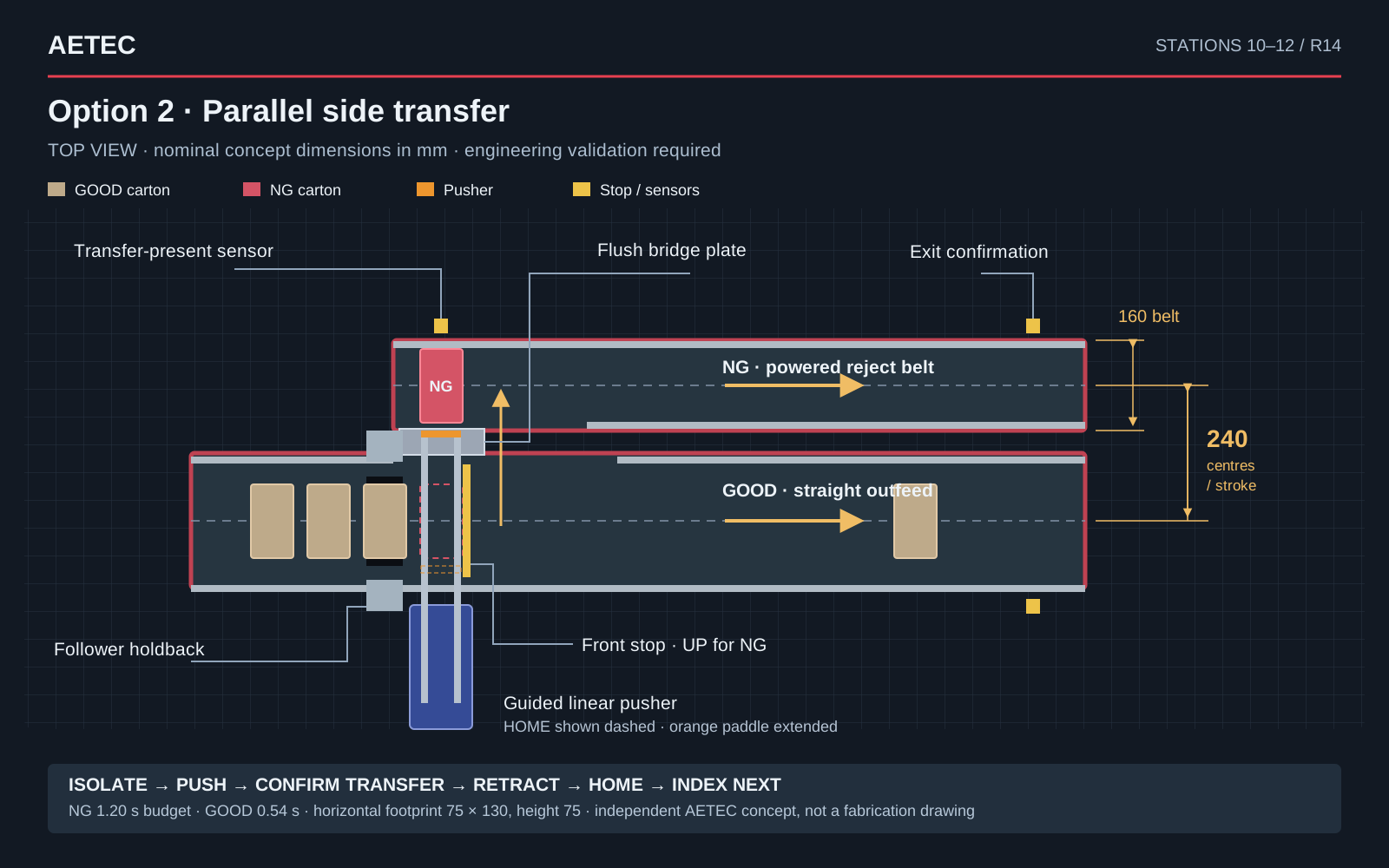
NG timing assumptions: isolate 0.10 s → push 0.55 s → transfer confirmation 0.07 s → retract 0.28 s → next-carton index margin 0.20 s. Total 1.20 s. GOOD uses the 0.54 s straight-through budget. Mixed-flow capacity uses the weighted route time, with upstream release matched to the bottleneck.
Confirm actual carton dimensions, bottle mass / centre of gravity, carton stiffness, friction, stroke acceleration, belt handovers and sensor response with samples before fixing the actuator or production cycle. This layout is a concept drawing.
Station 12 and downstream carton identity
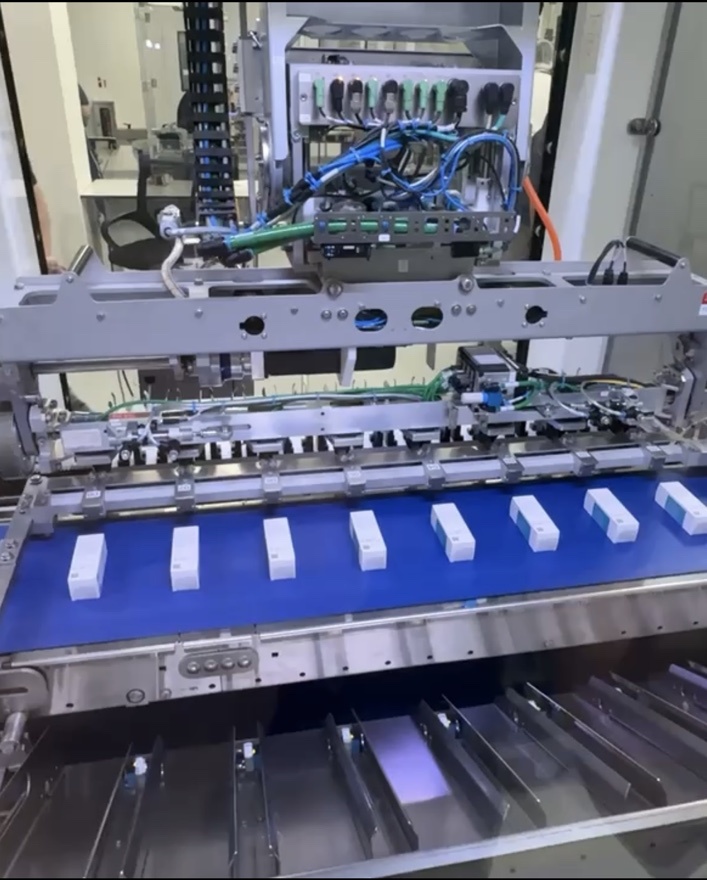
Station 11 loads. Station 12 closes.
The existing Station 11 robot places bottles into cartons. The Station 12 carton module and outfeed belt are parallel and adjacent. The robot picks eight loaded cartons, closes them locally and makes a short sideways transfer before laying them flat. The animation uses an eight-carton group to explain the handover; confirm the actual closing tool and motion sequence with the OEM.
A · Tracking only
Retain the carton identity registered at Station 11. Bind the Station 12 placement event to the conveyor encoder count, observed position and sequence. AI observations and zone sensors maintain that association until the confirmed good / reject exit. No QR is read through the belt.
Key limitation: slip, removal, reordered cartons or missed observations can corrupt the association. On disagreement, HOLD and reconcile the physical queue before release. Sequence counting alone cannot guarantee the correct reject.
B · Additional stand-up QR re-read
Isolate one carton and hold its follower. Clamp and stand it up to expose the QR. Confirm upright position, stabilise and acquire a fresh QR. Compare it with the reserved identity, lay the carton flat, confirm HOME / clearance and release to the selected sorting design.
This gives direct QR confirmation before sorting. It still requires reliable handovers and exit confirmation. Unexpected identity or mechanical feedback failure causes HOLD; a known isolated carton with a no-read is marked NG.
Additional option scope: conveyor section modification, supported tilt fixture, actuator, holdback, position sensors, Vision System and lighting, PLC sequencing, guarding and trials. Pricing and contractual inclusion remain subject to confirmation.
Engineering basis and scope notes
The demonstration follows the latest Station 10 discussion: articulated XYZ handling, eight independently stopping rotary axes, 16 movable vision heads, motorised fore/aft focusing, self-calibration / self-focus sequence, anti-vibration handling, separate bottle and carton travel-unit fleets, Station 11 simultaneous eight-bottle loading, AI placement tracking, separate downward turns and lower returns, carton matching, Station 12 local closing / short transfer to a parallel belt, QR-hidden tracking and optional stand-up re-read, closure inspection and confirmed rejection.
The three generic bottle-design presets illustrate different shapes, dimensions and recipe positions. Design A uses the supplied reference geometry and 100 mm pitch for scale. These demonstration presets are not approved production recipes. Additional products require recipe programming and validation. Lens magnification, focus travel, vibration limits, robot payload, holder clearance and the complete 4.8-second target cycle need engineering validation.
Optical design note: the latest discussion calls for high-magnification lenses and automatic focus tracks. Quotation Q909526012A uses a QR ≥1 mm / lower-magnification baseline; final optical and AI-tracking scope must be reconciled during design freeze. This revision illustrates the latest requested carton closure / packaging-condition checks. The final inspection criteria, hardware arrangement and commercial scope need reconciliation; the model does not establish contractual coverage.
The supplied Q909525011A overall-system drawing / proposal provides background for upstream QC and marking. Its earlier overall equipment quantities are not Station 10 quantities. Reference process: upstream bottle QC / marking → transfer module → Station 10 → Station 11 loading → Station 12 closing / horizontal placement → QR-hidden conveyor tracking or optional re-read → sorting. Empty modules return separately to Station 1.
Timing budget, not a measured result: Station 10 work 4.0 s + inter-module exchange 0.8 s = 4.8 s batch takt. Local module circulation assumes 4.0 s Station 10 + 1.2 s forward transfer + 4.0 s packaging + 3.45 s empty return + 0.55 s upstream reload / indexing = 13.2 s. Thus ceil(13.2 / 4.8) = 3 modules, with 1.2 s fleet margin. The separate carton loop uses an illustrative 16.8 s budget, requiring ceil(16.8 / 4.8) = 4 carton modules. These are provisional quantities. The 0.55 s bottle-supply allowance does not establish the cycle times of the customer’s other upstream stations. Add their net delay in the capacity control.
Stations 11 and 12 must each clear eight cartons every 4.8 s. The S12 demonstration budgets 0.75 s carton-module indexing, 0.25 s presence check, 3.20 s handling and 0.60 s exchange margin and does not establish the actual OEM cycle. Carton metering uses a 0.54 s cycle: hold follower and position gate (0.12 s), release interlock (0.04 s), transfer / tail-clear (0.34 s), clearance margin (0.04 s). The model capacity is 111.1 cartons/min at the diverter. Actual carton dimensions, stability, guide friction, actuator response, optical timing, upstream supply and all sensor margins require validation.
100 good cartons/min is the normal-operation target with zero rejects and no downtime. At rejection fraction r, good output = routed rate × (1 − r). Delivering 100 good/min at 5% rejection requires at least 105.3/min upstream and sufficient capacity at every station.
Design references: KEYENCE industrial C-mount camera · Dorner gate, diverting and paced conveyor examples. These references guide the concept; no vendor performance certification is implied.